At a recent show, someone asked if I made lavender/vanilla scented soap, to which I replied "no". I went on to explain that there is no vanilla essential oil and since I don't use artificial scents, there was, therefore, no way for me to get a vanilla scent.
She protested. Insisting that she used vanilla essential oil herself. I certainly wasn't going to argue with her since she was, after all, a potential customer, but I was pretty sure she was mistaken. Pretty sure...
So, when I got home that evening, I went straight to the Internet and googled "vanilla essential oil". Guess what? People sell something called "vanilla essential oil". But, there is no such thing vanilla essential oil. There isn't. So what are they selling and how is it legal?
I don't know about the legalities, but I'm guessing they can get away with it due to convenient vagaries in the legal code surrounding the definition of "essential oils". In fact, there actually is no regulatory standard governing the use of the term "essential oil".
However, it seems to be generally accepted that essential oils are, in large part, defined by the method with which they were extracted. More specifically, they must be either steam distilled or, in the case of citrus oils, cold pressed. The problem is, some plants, like vanilla, are too delicate and cannot withstand the heat involved in the steam distillation process. So, in order to extract the essence of these plants an alternative method must be employed. In regards to vanilla, this typically means solvent extraction or CO2 extraction.
CO2 extraction can actually yield a very high quality product. In this method, relatively cool CO2 is pressurized and pumped through the plant. When the pressure is released, the CO2 escapes as a gas, while the plant oils remain behind. There are no residues or solvents in the final product, so this is probably as close to a vanilla "essential oil" as you are going to get. However, if this is what you want, be prepared to pay for it. It is very expensive and downright prohibitive for me at this stage in the game. It will likely be called an absolute, but pay close attention to the extraction method. Absolutes can also be extracted with hydrocarbon solvents (like hexane), which you may not want in your natural products.
The other common type of concentrated vanilla that is available is called an oleoresin. Oleoresins are extracted with solvents. The solvent is then removed. During this final distillation process, some of the aromatics are lost, but a strong oleoresin (as determined by a higher "fold" number) can still give a pretty good flavor and smell. Oleoresins are commonly used in the food industry to make the extracts many of us cook with. Although it seems like oleoresins would be cheaper to produce than absolutes, they often are still very expensive. At least the good ones are.
If you have found a cheap source for vanilla "essential oil," I hate to break it to you, but you are probably getting a cheap product. More than likely, it has been pre-diluted in a carrier oil or otherwise adulterated in some way. I'm not saying it won't work in lotions, balms etc... but these won't work in cold process soap and who knows what it is really made of.
Personally, I like to know that the products I use are pure and do not contain unnecessary solvents, chemicals or other miscellaneous junk. So for now, I think I will just avoid vanilla, but at least now I will be prepared to explain myself the next time I declare"there is no such thing as vanilla essential oil."

Thursday, July 28, 2011

Sunday, May 29, 2011
Breaking the Rules- Going Rogue and Making Soaping Fun Again
If you've read my blog at all, you know by now that I don't do anything haphazardly. I research whatever topic has caught my interest until I feel confident that I can make a responsible, well reasoned decision, whether it is about which oils to use or which additives to avoid. So, as you can probably imagine, I was equally attentive to the soapmaking process when I first began... doing my best to follow each recipe to a T and panicking if even one extra gram of EVOO found its way into the batch. But honestly, that didn't last long!
In a lot ways, I find traditional methods a bit... well... a bit asinine. There. I said it! And its true.
As you read through the established rules of soapmaking, you see that conventional wisdom requires adding fragrance, colors and any other special ingredients at trace and mixing well. This all sounds fine, but then you read a little more and come to learn that once you reach trace, the soap will thicken quickly and you don't have much time to work... not only that, but some additives will clump; others will further accelerate trace and hasten the whole frantic process even more. Soon, it becomes a race against time and science to incorporate scent, color, and clump-free oatmeal in the few brief moments before the soap thickens. Excuse my language... but what a freakin' nightmare!
I know it goes against everything we've learned as soapers, but close your eyes, hold on to your hats and get ready for an earth shattering revelation: I don't add anything at trace... ever! I used to. And every time I did, I buckled under the pressure. It usually ended with me throwing my half mixed, thick and clumpy mess of a batch into the mold in a final hail Mary attempt to salvage the pitiful remains of my once grand vision.
Then I read about someone who adds their scent to their oils before adding their lye. And something clicked. If you can do this with scent... why not other things? Soon, I began adding everything to my oils before the lye, and you know what? It works!
I've never found any research to suggest that I should or shouldn't do it this way, but I suppose, in the absence of knowledge, I can let common sense prevail.
In a lot ways, I find traditional methods a bit... well... a bit asinine. There. I said it! And its true.
As you read through the established rules of soapmaking, you see that conventional wisdom requires adding fragrance, colors and any other special ingredients at trace and mixing well. This all sounds fine, but then you read a little more and come to learn that once you reach trace, the soap will thicken quickly and you don't have much time to work... not only that, but some additives will clump; others will further accelerate trace and hasten the whole frantic process even more. Soon, it becomes a race against time and science to incorporate scent, color, and clump-free oatmeal in the few brief moments before the soap thickens. Excuse my language... but what a freakin' nightmare!
I know it goes against everything we've learned as soapers, but close your eyes, hold on to your hats and get ready for an earth shattering revelation: I don't add anything at trace... ever! I used to. And every time I did, I buckled under the pressure. It usually ended with me throwing my half mixed, thick and clumpy mess of a batch into the mold in a final hail Mary attempt to salvage the pitiful remains of my once grand vision.
Then I read about someone who adds their scent to their oils before adding their lye. And something clicked. If you can do this with scent... why not other things? Soon, I began adding everything to my oils before the lye, and you know what? It works!
I've never found any research to suggest that I should or shouldn't do it this way, but I suppose, in the absence of knowledge, I can let common sense prevail.
Friday, May 13, 2011
If Soap Were Superman
 If cold process soap were superman then water, surely, would be its kryptonite. It seems like soapers are always reminding their friends and customers to use a well draining soap dish and to ensure full air circulation around the entire bar between uses... yet there is always someone lamenting the bar that turned to mush and melted away. They blame the ingredients, poor craftsmanship, or anything else they can think of. But who's really to blame?
The fact is, most handmade soap (even 100% olive oil soap) will last quite a while if it is kept dry between uses, but the reality is, it can be very hard to keep a bar of soap dry. It is hard to find a really good soap dish that allows for air circulation around the entire bar. It is hard to find a perfect spot in the shower that is both convenient and dry; and all of this is even harder if you live in a moist climate like New England where even towels (let alone soap) may never fully dry between uses.
I sometimes take my situation for granted. I live in the dry, arid land of Utah where 15% humidity feels muggy. I have a rain shower head that juts out about 15 inches from the wall and showers water straight down at a 90 degree angle rather than splashing water all across the tub, and I have a slatted shower shelf that hangs off the base of the shower head a full 15 inches from the nearest drop of water. My soap lasts FOREVER!
But for those who are not so lucky, what can you do? If you don't want to remodel your bathroom or move to the desert, really the best thing you can do is find a well draining soap dish. I know, I know... you already have one right? But, do you really?
Let me ask you this: Is it a shallow slatted dish perched atop a deeper non-draining dish? If so, how often do you empty the lower dish out? In my experience, it seems that no matter how careful you are, water will collect in that lower dish and if the soap is stored up above the water, the soap may be dry, but there really isn't that much room for air to circulate around it. So, these dishes can work, but you must be diligent in emptying the water out. You also have to keep it in a dry place. On the edge of the tub just outside the shower curtain is a great. Other people I know have tried dishes with spikes on them, which seem like a great idea, but only seem to work moderately well, maybe the problem is with location... I don't know.
I personally really like the idea of this dish, which I found on amazon.com. It attaches to the wall of your shower, allows water to completely drain away from the soap and allows air to circulate all the way around the bar. People seem to have mixed luck with the suction cups, but when searching for the perfect dish, this is exactly the type I would look for.
Oh, and my final recommendation: If you have a little soap shelf built into the side wall of your shower, do not EVER use this for soap... EVER! For some reason, these little shelves always seem to be located in the one area of the shower that gets hit with water non-stop. And they usually have divots or ridges or other infuriating structural components that seem to attract and collect water. Maybe it is just me, but in my experience it is impossible to keep anything dry on these little shelves.
So, for the best, longest lasting bar, treat your soap like superman: accept that water is its kryptonite and and do your very best to keep it dry between uses. It is well worth it in the long run!
Saturday, March 12, 2011
Felted Soap
I've always wanted to be one of those people who could find the one thing in life they are really passionate about, then work really hard to master their craft and excel in their field. Unfortunately, I lack that type of focus and I am quickly distracted by shiny objects and new challenges. Not just in crafts, but in all aspects of life. Even when doing chores around the house, I often leave things half done as I move onto the next task that catches my eye. Eventually, I finish all that I started, but if someone were to stop by while I'm "cleaning" they'd have a hard time determining whether I'm actually putting things away or pulling things apart.
Anyway, the point is...I like to keep busy and having a variety of things to do keeps me interested. In addition to soap making, one of my many interests is fiber arts. I love knitting, weaving, spinning yarn and... you guessed it... felting! It is funny though... I have been watching fiber artists felt soap long before I ever knew how to make a bar of soap, but it wasn't until recently that I decided to try my hand at it. I have PLENTY of wool sitting around and a fair amount of ugly soap to boot. It seemed like a match made in heaven. But as the saying goes... jack of all trades, master of none... What a disaster!
I started out thinking it would make a great tutorial for this blog, but about 30 minutes into felting, I realized that I had made one major rookie mistake. At that point, I quickly abandoned the project and decided that I should leave the teaching to the pros! BUT, I decided to share my rookie mistake, which is a well known rule among fiber artists, but rarely mentioned on the soap blogs. Ready? Here it is:
Happy felting!
Anyway, the point is...I like to keep busy and having a variety of things to do keeps me interested. In addition to soap making, one of my many interests is fiber arts. I love knitting, weaving, spinning yarn and... you guessed it... felting! It is funny though... I have been watching fiber artists felt soap long before I ever knew how to make a bar of soap, but it wasn't until recently that I decided to try my hand at it. I have PLENTY of wool sitting around and a fair amount of ugly soap to boot. It seemed like a match made in heaven. But as the saying goes... jack of all trades, master of none... What a disaster!
I started out thinking it would make a great tutorial for this blog, but about 30 minutes into felting, I realized that I had made one major rookie mistake. At that point, I quickly abandoned the project and decided that I should leave the teaching to the pros! BUT, I decided to share my rookie mistake, which is a well known rule among fiber artists, but rarely mentioned on the soap blogs. Ready? Here it is:
DON'T USE SUPER WASH WOOL TO FELT
What is super wash? Have you ever had a wool sweater that advertises that it can be washed without shrinking? THAT is super wash and because it doesn't shrink... it doesn't felt. Normally, I would never use super wash wool for anything because of the extra processing and treating it undergoes, but when I was learning to spin yarn, I bought whatever wool was cheapest...and I never labeled the bags. So there's lesson #2: label everything! Had I labeled everything, I could have gone back, grabbed some NON-super wash wool and created a useful tutorial. Instead, here is a link to somebody else's great tutorial :) http://www.mielkesfarm.com/felt_soap.htm
If you get the right wool, felting really is fun! And it is a great way to hide your less than perfect soaps!
One thing to keep in mind, if you are concerned about chemicals and/or your ecological impact, is that when it comes to wool, natural dyes are not necessarily a better/safer choice than synthetic. In the dying process, natural dyes are usually anchored by mordants. The type of mordant varies depending on the color used, but typically mordants are powdered metals or metallic salts and can be toxic (though not necessarily). But, if you want to play it safe and reduce your exposure to unnecessary toxins, I would simply use natural undyed, wool, which is available in many colors from white to beige, brown, grey and black... plus, you can rest easy knowing the color will never wash off in the shower!
Happy felting!
Saturday, February 19, 2011
Lotion Bars- Who? What? Why?
 With all types of luxurious oils like shea, and hempseed just laying around between soap batches, it wasn't long before I began wondering what else I could do with these oils. My first thought was lotion. It is SOOO hard to find a truly organic, all natural lotion, so why not make one myself!
Well, after reading about the ins and outs of making lotion at home, I decided that it wasn't for me for several reasons. First off, it is extremely risky. Even the most seasoned lotion makers seem to have a healthy concern for bacteria. As a precaution, most send samples of their lotion to labs for testing to ensure they are selling a safe, healthy product to their patrons. But even before you have to find a lab, send out samples and cross your fingers, there are several other stumbling blocks to making a truly natural lotion.
First, the nature of lotion (a combination of oils and water) requires an emulsifying agent. Unfortunately, even emulsifiers that begin with natural ingredients are often heavily manufactured and processed to the point that the word "natural" can not really be used ethically to describe the polluted, processed product that results.
But, maybe one does exist. I will admit, it is possible that I just didn't look hard enough because I was looking ahead to the next hurdle. Preservatives. Anytime water is added to oils a preservative becomes necessary. And, there are no natural preservatives. Period. Many people will use grapefruit seed extract or vitamin e, but these are antioxidants, not preservatives. They will not prevent bacteria growth and are not sufficient for lotions. This is where my hope and aspirations deflated. Bleh...what now?
Lotion bars! Unlike lotion, lotion-bars are made entirely of oils and waxes. There is no water added so... no preservative necessary! They are different though. For starters, they are solid... but they are pretty cool! You can rub them on the backs of your hands, or all over your feet, elbows or knees and as the natural warmth of your body heats them up, they begin to melt leaving behind soft, beautiful skin! Personally, I love them! But are lotion bars for you?
Here is my take:
Who- Lotion bars are great for hands, feet etc. no matter who you are. As an all over body moisturizer, they tend to be better for younger skin, or those who are committed to natural, organic products.
Why- There are several great benefits to lotion bars over traditional lotions:
- Less messy, less greasy and more easily absorbed than many lotions.
- Completely natural! No preservatives, no chemicals, no artificial anything!
- Airplane friendly!! As a solid, these babies can be packed away and taken on airplanes with you anywhere in the world
Saturday, February 5, 2011
What does natural mean?

How does the FDA regulate the use of the term "natural"?
The only industry subjected to increased government controls when applying the term "natural" is the meat and poultry industry. According to an article published on the FDA's website, natural meat and poultry must be free from artificial colors, flavors, sweetners, preservatives and any other ingredients that do not occur naturally. It also must be minimally processed and the label must explain what is meant by the term "natural" (for example, "no artificial ingredients").
Why isn't there more regulation?
The FDA contends that that the term natural has not been defined or regulated outside of the meat industry because it is not a priority. They have not seen enough evidence that the current situation has resulted in consumers being misled. Instead, they focus their limited resources on misleading health and nutrient claims and other claims that may impact consumers health and safety, such as allergy labels.
Does the FDA plan on regulating the use of the term "natural" anytime soon?
It doesn't look like it. However, it may come under review if they are presented with substantial evidence that consumers are being misled.
In the mean time...
It is important to take personal responsibility for the choices and decisions you make as a consumer. Personally, I wouldn't abandon "natural" products... just educate yourself. Read the labels and buy brands you trust. Do your homework when you have to. Long, Latin words in the ingredients aren't necessarily bad just because you can't pronounce them. Some products (like cosmetics) are required to be labeled this way. If you are not sure what an ingredient is, throw it into google and find out if it fits your definition of natural. It takes a little time up front, but from then on out you will know!
What does "natural" mean to Spotted Hippo?
- No artificial colors- we only use products that are derived naturally from the earth and plant materials
- No micas or oxide colorants- while these occur naturally, the micas and oxides approved for cosmetic use are synthetically produced... so you won't find them in Spotted Hippo!
- No synthetic fragrance- we use only pure essential oils to scent our soap.
- No artificial flavors- Spotted Hippo lip balms use pure essential oils or certified organic flavor oils (flavors naturally derived from organic plant materials)
- No petrochemicals or hexane- All Spotted Hippo products are free from petrochemicals and all oils are naturally extracted without the use of hexane or other chemicals
- Ethically produced- We are committed to finding and using products that are:
- Sustainably grown and manufactured
- Certified Organic or wild crafted
- Pesticide free
- GMO free
- Fairly traded
- Have minimal impact on the environment
Sunday, January 16, 2011
Disecting Dove
 |
| Spotted Hippo Soap's "Simply Soap" |
First off. Look on a package of Dove and you will notice the word "soap" is never used to describe the product. That is not an accident. It is because Dove (like many mass produced bars) is not soap. The FDA defines soap in the following way:
- The bulk of the nonvolatile matter in the product consists of an alkali salt of fatty acids and the product's detergent properties are due to the alkali-fatty acid compounds, and
- The product is labeled, sold, and represented solely as soap [21 CFR 701.20].
INGREDIENTS IN WHITE DOVE
- Sodium Lauryl Isethionate: Well, there is not a lot of information available, but it is basically a synthetic detergent. It is a synthetic chemical produced in a laboratory. Used as a detergent, wetting agent and/or emulsifier. Products containing synthetic detergents are not considered "soap" under the FDA's guidelines. Instead, it would either fall under the category of a cosmetic or a drug, depending on how it is marketed.
- Stearic Acid: This is a fatty acid, usually derived from animal fat. It is created in a laboratory by hydrolyzing the triglycerides in the fat (typically beef fat or tallow). It can also be derived from palm oil and a few other sources, but these types of stearic acid are very limited in the United States. It is widely used in the soap industry as a hardener.
- Sodium Tallowate or Sodium Palmitate: Sodium Tallowate simply refers to tallow (animal fat) that has been combined with sodium hydroxide (lye). Likewise, Sodium Palmitate refers to palm oil that has been combined with sodium hydroxide (lye). Many handmade soapers will list their ingredients like this as well. The theory being that no lye actually remains in the final soap, so rather than listing lye separately on the label (which may turn some consumers off) they simply list the product that results from combining lye with the tallow or palm oil.
- Lauric Acid: Lauric Acid is the main fatty acid in coconut oil and palm kernal oil. Because of their high lauric acid content, these oils can be used to add hardness to a bar of soap. In addition to these naturally occurring sources, lauric acid can be produced in a laboratory. It would be used to add hardness the "soap".
- Sodium Isethionate: This is another synthetic detergent. Typically added because of its ability to bind to compounds not readily soluble in water. Also called a surfactant.
- Water: I'm going to assume everyone knows what this is ;)
- Sodium Stearate: This is another synthetic detergent or surfactant. It is typically used as a cleaning agent, an emulsifier and as a way to increase viscosity.
- Cocamido Propyl Betaine or Sodium C14-C16 Olefin Sulfonate: Cocamido Propyl betain is a synthetic surfactant that is used as a cleansing and foaming agent, but can also be added as a skin conditioning agent. Sodium C14-C16 Olefin Sulfonate is a synthetic surfactant used as a cleaning agent and foam booster.
- Sodium Cocoate or Sodium Palm Kernelate: This refers to coconut oil or palm kernel oil that has been combined with sodium hydroxide (lye).
- Fragrance: This refers to synthetic fragrance that has been developed in a lab. There are several thousand ingredients that can be used in fragrance yet because they are governed under trade secret laws, none of the ingredients need to be disclosed. To find out more about fragrance oils, check out my previous post.
- Sodium Chloride: Common table salt. This is used in commercial manufacturers in a process to separate out and remove the glycerin that naturally forms during saponification. It can also be added to soaps to make a more lotiony feeling lather.
- Tetrasodium Edta: A synthetic chelating agent used to improve performance in hard water. (You may notice that soap does not lather as much in hard water... this is basically a synthetic ingredient that addresses that issue).
- Tetrasodium Etidronate: Another synthetic chelating agent, again used to minimize the undesirable effects of hard water on lather by locking the calcium and magnesium in the water.
- Titanium Dioxide: This is a naturally occurring oxide, however it is produced synthetically for the cosmetic industry. It is used as a pigment to create very white colored soap.
On the other hand, here are the ingredients from Spotted Hippo's "Simply Soap":
- Organic Coconut Oil- Adds hardness and bubbly lather.
- Organic Palm Oil- Sustainably sourced from South America, contributes hardness and a creamy, stable lather.
- Organic Extra Virgin Oil- Used for its moisturizing qualities.
- Organic Castor Oil- Used for its great moisturizing properties and creamy stable lather.
- Distilled Water- Good ol' H2O
- Sodium Hydroxide- This is lye. Although there is not actually any lye in the final product, I choose to list it this way so people know what went into the making of the product.
Thursday, December 16, 2010
Palm Oil- The Dark Side of Vegan Soap

Palm oil really is an amazing oil. Take a quick look around your house and you'll likely see dozens of products that contain palm oil. It may show up in anything from chocolates, cookies, crackers and other snack foods, to dish soap, detergents, and a wide variety of personal care products. Palm oil is also widely used to make bio-diesel fuel and, of course, soap. It is especially popular in vegan soaps as an alternative for animal tallow. Unfortunately, with so many industries bolstering the palm oil industry (which is largely based in Malaysia and Indonesia), many palm oil producers have resorted to unethical practices to keep up with demand, the effects of which have been devastating on the environment and wildlife in regions where palm oil are grown.
A report released by the UN illustrates just how large this industry has become: "Palm oil and palm kernel oil now make up one of the largest shares of global vegetable oil supply. Indonesia and Malaysia account for 83% of the global production of palm oil."
In this part of the world, the palm industry is largely controlled by multinational corporations with little regard for the horrific consequences of their financial pursuits. In fact, rapid expansion of palm oil plantations throughout Indonesia and Malaysia is the primary cause of rain forest loss in the region and consequently the leading cause of habitat loss for the already endangered orangutan. As palm plantations have encroached on and destroyed the orangutan's home, human and orangutan conflicts have increased, leading many plantation workers to kill orangutans on site. Other orangutans are simply starving to death as their forest home disappears. It is tragic to read about. Even more so when you know how uniquely amazing orangutans are. You can read more about them here.
What's worse is that much of the increase in demand for palm oil is being fueled by the increasing interest in using biodiesel fuels to reduce CO2 emissions. However, the grim irony is that because fire is often used to clear forests and establish palm plantations, these biofuel sources are actually doing more environmental damage than burning fossil fuels would.
With such a damning reputation, my initial response was to avoid palm oil all together... focusing instead on creating bastille type soaps at least until I could research the issue in more depth. When I finally did, what I found was a great organic, sustainable and responsible source from South America. Here is what our supplier says:
"The plants are grown in a mixed species environment with legume under story to provide nitrogen specific plants to host, and feed beneficial insects. Residue from the oil pressings is also returned to the groves to provide nutrients. The farm is in a region of the Amazon that was cleared by previous owners 30-40 years ago, and the reestablishment of a forest crop has brought back many species of birds and other plants and animals. While not as diverse as native Rain forest, it is a vast improvement over grasslands."
I am so happy to be able to use this amazing oil in Spotted Hippo Soap and to be able to say with confidence that no orangutans were injured or killed in the making of our soap :)
To find out more about the plight of the orangutan please, check out the UNEP Report: The Last Stand of the Orangutan
To learn more about these amazing, quirky animals and their culture (yes. culture), please check out this PBS show: From Orphan to King
And to find out more about the organic, sustainable palm oil used in Spotted Hippo Soap, please contact Soapers Choice
Saturday, December 4, 2010
Nature's Inspirations: The Amazing Cuttlefish
If you have ever seen a cuttlefish, then I assume you already know how awesome these magical little guys are. If you haven't... you, my friend, are missing out! PBS aired a great show starring the amazing cuttlefish, which I highly recommend and, luckily enough, it is available online! You can watch it right here...
I was nearly giddy to find that a quick search on Etsy returned more than 200 pieces that place the cuttlefish front and center. From t-shirts to coasters, greeting cards to pendants, Etsy artists are giving a well deserved nod to this most amazing creature. And, with the holidays just around the corner, if you are looking for unique gift for the person who has everything (and is well stocked with soap!), you just may want to consider the cuttlefish! Here are a few of my favorites:
How cool was that? I think it is totally awe inspiring that a creature naturally evolved to be able to change not only its color, but also its pattern, shape and texture in an instant. So quickly, that it can hypnotize other animals by pulsing stripes across its body!! It is absolutely amazing. Imagine being able to create a natural soap that could do all that! I saw a glow in the dark soap today... but it just seems banal in comparison. *Sigh* Anyway, soap aside, many other artists have captured the magic of the cuttlefish.
I was nearly giddy to find that a quick search on Etsy returned more than 200 pieces that place the cuttlefish front and center. From t-shirts to coasters, greeting cards to pendants, Etsy artists are giving a well deserved nod to this most amazing creature. And, with the holidays just around the corner, if you are looking for unique gift for the person who has everything (and is well stocked with soap!), you just may want to consider the cuttlefish! Here are a few of my favorites:
 |
| lemayhem |
Lemayhem is a great artist from New Orleans who captures the intensity and intelligent curiosity of the cuttlefish in her print "Dear Cuttlefish" I equally love her humor as she muses about her Dear Cuttlefish's intentions while offering a little background behind the cuttlefish's historic role in the art world!
 |
| easykeeper |
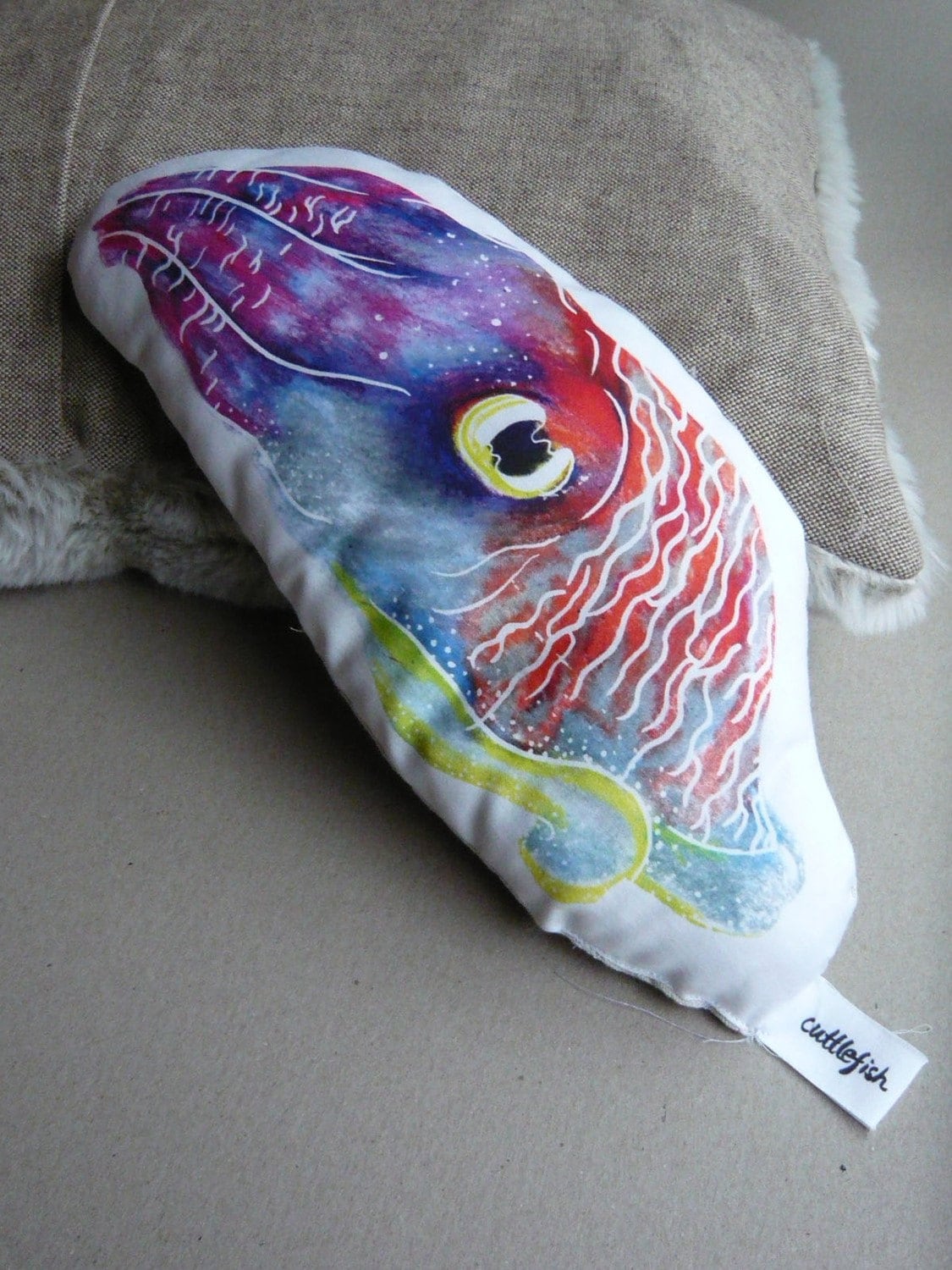
Easykeeper hails from Salt Lake City and does an amazing job of capturing the beautiful colors and magical skin of the cuttlefish with her Stuffed Cuttlefish Decorative Pillow Buddy. But this little guy is more than just a pretty face! Easykeeper's cuttlefish plush is printed on organic cotton and stuffed with all natural cotton fiber filling, making him a great natural addition to any home!
 |
| TypseyGypseyTees |
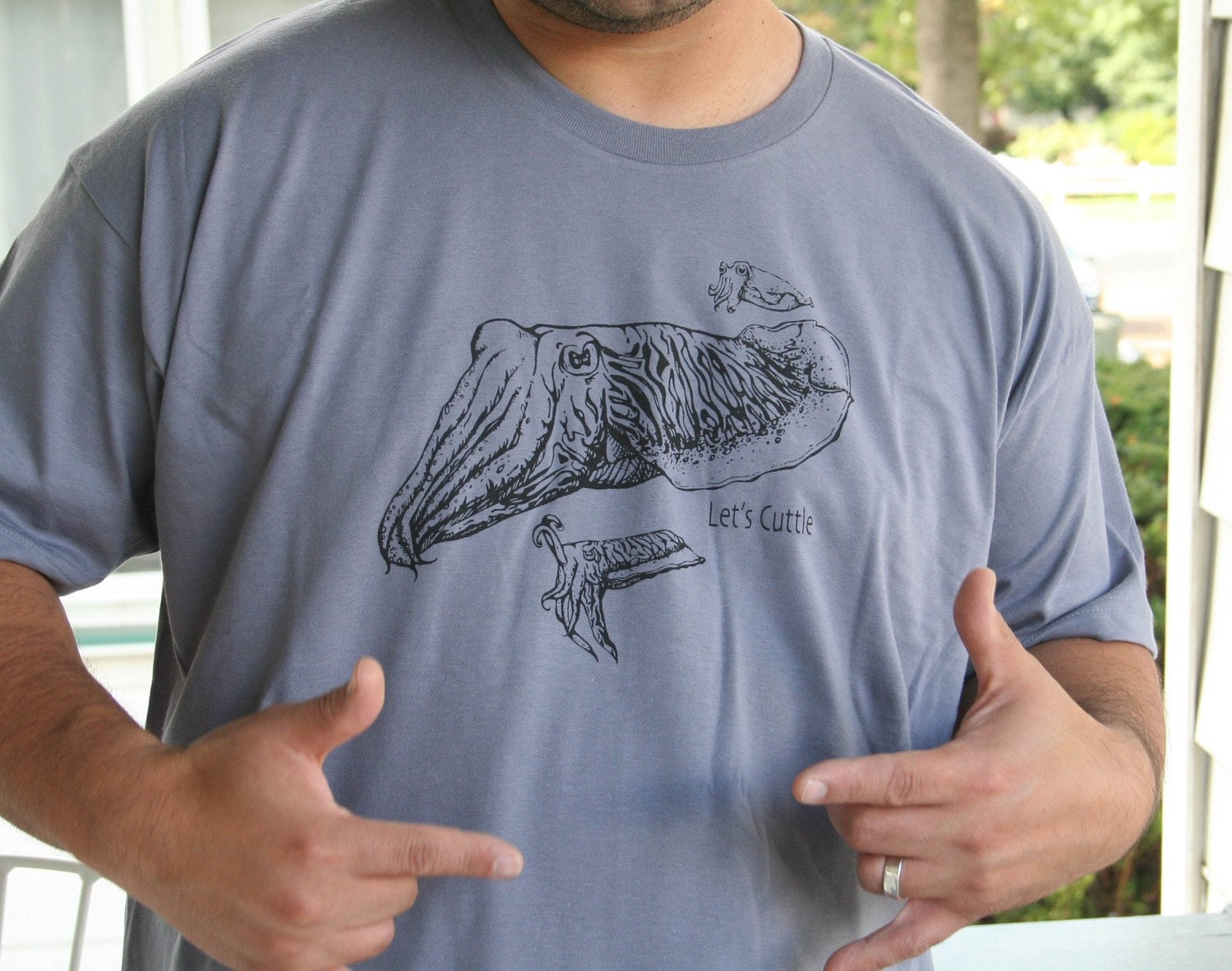
TypsyGypsy is another great "cuttlefish artist". Based in Philadelphia, she creates some of the most amazing sea creature tee-shirts. The best part is, if you read her profile you will learn, all of these great designs were inspired by her 5 year old son and his precocious interest in unusual sea life! I love it! And I love her intricate representation and adorable (without being cutesy!) play on words in this wonderful tee-shirt design: "Lets Cuttle"!
 |
| The Bonheur Letters |
Finally, The Bonheur Letters of Barcelona. What a magical little slice of Etsy this shop is! Each print comes to life as the quirky personalities and daily routines of the characters are revealed. Mr. Cuttlefish Sitting in a Wishbone Chair is certainly no exception. Find out all about Mr. Cuttlefish and his proclivity for daily news at The Bonheur Letters Etsy shop!
Wednesday, December 1, 2010
Fun for Free!
 |
| Green Clay from MRH |
I've seen unrefined butters with dirt and grit embedded in the butters... french green clay that looks more like grey, brown muck... and essential oils that fade or have an off scent and could easily ruin your soap. This is when experimenting becomes less of a fun adventure and more of costly nightmare.
 |
| Colored with Turmeric from MRH |
Mountain Rose Herbs is a great company nestled away in the funky little city of Eugene, OR. They offer an extensive selection of natural and organic products free from pesticides and many other toxic chemicals. And right now, if you go to http://mountainroseblog.com/giveaway1/ you can find out how to enter for a chance to win some of their amazing products!
They have a french green clay of such high quality that it stays green in CP soap, pesticide free essential oils, and organic oils, butters, herbs, and teas at affordable prices! They are by far one of my favorite businesses!
Sunday, November 28, 2010
The Castor Canundrum: Miracle Bean or Toxic Curse?
Castor Oil:
Castor oil is a wonderfully unique oil, rich in glycerin esters of ricinoleic acid. It is widely used throughout the world in everything from industrial applications to folk remedies and, of course, in soap! It's unique composition adds many wonderful qualities to soap. It promotes a rich bubbly lather, is very soothing and acts as a humectant to draw moisture to the skin. But it is not without controversy.
Background: How did Castor Oil Get Such a Bad Rap?
Over and over again, people purporting to take a moral stand use the same argument to demonize Castor beans. Word for word, that argument is this:
"Allergenic compounds found on the plant surface can cause permanent nerve damage , making the harvest of Castor beans a human health risk."
You can find this exact phrase here and here and here and here and, sadly, even here on one of my FAVORITE company's blog.
It is also written word for word on several forums, including:
http://forums2.gardenweb.com/forums/load/herbal/msg0313453718512.html
http://archive.longhaircommunity.com/archive/index.php/t-73020.html
http://www.femalefirst.co.uk/board/stretch-marks-t22228-7230.html
http://riseofflight.com/forum/viewtopic.php?f=49&t=11529
And the list goes on and ON AND ON.
I'd be willing to bet most of these people pulled this off of Wikipedia, which cites their source for their information as: http://www.linnaeus.net/problem_with_castor.htm Go to this site and you'll see there is no further citation, no stats and no data to back it up. In fact, I can not find ANY hard stats or data on ANY of the sites that use this phrase.
The Facts:
Well, the same risks and ailments are common among
I think some people like to target Castor because it is largely produced in developing countries. They argue that the workers are at greater risk because of laxed labor laws etc. But I think the above studies, which were conducted all over, from Papua New Guinea to Croatia to Tennessee demonstrate that the same occupational hazards exist everywhere.
The fact is, many of the foods we eat and the things we enjoy entail some level of occupational hazard for the workers involved. From firemen and cops to coal miners and crab fishermen, people risk their life every day so that the rest of us can enjoy the many things this world has to offer. It is simply ridiculous to target Castor oil and boycott it as if it were a singular offender.
Disposal of the Ricin Rich Mash
Another concern people frequently have regarding Castor oil is the waste mash that results from processing the beans. The mash contains all of the deadly ricin and is highly toxic, so can it really be disposed of safely? Yes! The "waste" actually has many wonderful uses:
Castor oil is a wonderfully unique oil, rich in glycerin esters of ricinoleic acid. It is widely used throughout the world in everything from industrial applications to folk remedies and, of course, in soap! It's unique composition adds many wonderful qualities to soap. It promotes a rich bubbly lather, is very soothing and acts as a humectant to draw moisture to the skin. But it is not without controversy.
Background: How did Castor Oil Get Such a Bad Rap?
- Castor beans contain ricin.
- Ricin is one of the most toxic substances found in nature. According to numbers released by the Center for Disease Control (CDC), one castor bean contains enough ricin to kill 300 people (http://www.globalsecurity.org/org/nsn/nsn-040206.htm)
- Ricin has been a known biological weapon since WWI and is considered a category B threat by the CDC, meaning it is in the second highest category of agents
- There is no known andecdote for ricin poisening
- Castor plants are also highly allergenic
- The majority of castor oil is produced in India, Brazil and China
- human rights concerns surrounding the factory and farm workers who harvest and process the beans
- the disposal of the ricin rich "mash"
Over and over again, people purporting to take a moral stand use the same argument to demonize Castor beans. Word for word, that argument is this:
"Allergenic compounds found on the plant surface can cause permanent nerve damage , making the harvest of Castor beans a human health risk."
You can find this exact phrase here and here and here and here and, sadly, even here on one of my FAVORITE company's blog.
It is also written word for word on several forums, including:
http://forums2.gardenweb.com/forums/load/herbal/msg0313453718512.html
http://archive.longhaircommunity.com/archive/index.php/t-73020.html
http://www.femalefirst.co.uk/board/stretch-marks-t22228-7230.html
http://riseofflight.com/forum/viewtopic.php?f=49&t=11529
And the list goes on and ON AND ON.
I'd be willing to bet most of these people pulled this off of Wikipedia, which cites their source for their information as: http://www.linnaeus.net/problem_with_castor.htm Go to this site and you'll see there is no further citation, no stats and no data to back it up. In fact, I can not find ANY hard stats or data on ANY of the sites that use this phrase.
The Facts:
- I found no substantiated evidence that exposure to the plant's leaves causes permanent nerve damage, in fact Castor plants grow quite readily throughout the United States (predominantly in Florida, Texas and California). They are even used as ornamental plants in gardens.
- However, prolonged contact with the plant's sap, flowers, seeds or leaves may result in a rash. If introduced to the eye, conjunctivitis may develop (you can read more here).
- Also, like ragweed, the Castor plant (Ricinus communis) does produce a great deal of pollen, which can cause allergies. In severe cases, people may develop asthma.
- Perhaps the most documented effects of Castor are seen in the factory workers where the oil is produced. Factory workers exposed to dust from the Castor seeds may develop allergies and suffer from asthma (you can read more here).
Well, the same risks and ailments are common among
- Coffee factory workers
- Cocoa bean processors
- Soybean factory workers
- Confectionery plant workers
- Spice processors
I think some people like to target Castor because it is largely produced in developing countries. They argue that the workers are at greater risk because of laxed labor laws etc. But I think the above studies, which were conducted all over, from Papua New Guinea to Croatia to Tennessee demonstrate that the same occupational hazards exist everywhere.
The fact is, many of the foods we eat and the things we enjoy entail some level of occupational hazard for the workers involved. From firemen and cops to coal miners and crab fishermen, people risk their life every day so that the rest of us can enjoy the many things this world has to offer. It is simply ridiculous to target Castor oil and boycott it as if it were a singular offender.
Disposal of the Ricin Rich Mash
Another concern people frequently have regarding Castor oil is the waste mash that results from processing the beans. The mash contains all of the deadly ricin and is highly toxic, so can it really be disposed of safely? Yes! The "waste" actually has many wonderful uses:
- The mash can be treated to inactivate the ricin then used as fertilizer or animal feed
- Certain parts of the plant and residue can be made into wallboard
- Ricin itself is being used to fight cancer by targeting and killing cancer cells
- Ricin also shows promise as a method to reduce bone marrow rejection after transplants
Wednesday, November 24, 2010
A Vegetarian atThanksgiving?!
Between traffic jams, family and the pressure of preparing a delicious multi-course meal for dozens of people, Thanksgiving can be trying enough without the added challenge of having to feed a vegetarian. But don't panic! It doesn't have to be hard. You don't need tofu, tempeh, seaweed or any other exotic ingredients. We vegetarians eat normal food too! Just last night, I made a delicious soup that would make a great, hearty meal for any vegetarian and most of the ingredients are things you'll have around on the big day anyway!
You'll need:
3 Yukon Gold Potatoes
A dash of extra virgin olive oil
1/2 an onion
2 carrots
2 stalks of celery
2 vegetable bouillon cubes+ 4 cups of water (or 4 cups of veggie stock/ broth)
1 can of diced tomatoes
1/2 cup of peas
1/4 cup tiny star pasta (optional)
And a dash of:
soy sauce
salt
pepper
nutmeg
ground coriander
celery seed
parsley
sugar
...or anything you have laying around! These are just the things that I had.
Directions
In one pot, bring your peeled and halved potatoes to a boil. Cook until they just begin to soften, but are still fairly firm. When they are the right consistency, remove them from the pot and chop into 1 in pieces.
In a second pot, pour a dash of olive oil on the bottom. Add the onion, carrots and celery and saute for about 5 minutes, or until the onions begin to get tender. Add 4 cups of water and the bouillon. Bring to a gentle boil. Add the remaining ingredients (except the peas, star pasta and potatoes). Simmer for 30 minutes. Add the peas, star pasta and potatoes. Simmer for 10 more minutes.
Voila! Your veggie friend now has a delicious, hearty, healthy dish to enjoy with your rolls, mashed potatoes, cranberry sauce, salads, and all your other naturally veggie dishes!
HAPPY THANKSGIVING!!
You'll need:
3 Yukon Gold Potatoes
A dash of extra virgin olive oil
1/2 an onion
2 carrots
2 stalks of celery
2 vegetable bouillon cubes+ 4 cups of water (or 4 cups of veggie stock/ broth)
1 can of diced tomatoes
1/2 cup of peas
1/4 cup tiny star pasta (optional)
And a dash of:
soy sauce
salt
pepper
nutmeg
ground coriander
celery seed
parsley
sugar
...or anything you have laying around! These are just the things that I had.
Directions
In one pot, bring your peeled and halved potatoes to a boil. Cook until they just begin to soften, but are still fairly firm. When they are the right consistency, remove them from the pot and chop into 1 in pieces.
In a second pot, pour a dash of olive oil on the bottom. Add the onion, carrots and celery and saute for about 5 minutes, or until the onions begin to get tender. Add 4 cups of water and the bouillon. Bring to a gentle boil. Add the remaining ingredients (except the peas, star pasta and potatoes). Simmer for 30 minutes. Add the peas, star pasta and potatoes. Simmer for 10 more minutes.
Voila! Your veggie friend now has a delicious, hearty, healthy dish to enjoy with your rolls, mashed potatoes, cranberry sauce, salads, and all your other naturally veggie dishes!
HAPPY THANKSGIVING!!
Wednesday, November 17, 2010
GMO what's the BFD?-- Part 2
Effect on Farmers
Background
1970- The US Congress passed the Plant Variety Protection Act (PVPA) giving breeders up to 25 years of exclusive control over a new, distinct varieties of plants with a few important exceptions. Most notably, under the PVPA, farmers using protected varieties of seeds were allowed to collect seeds from their crop each season for planting the following year.
1980- The Supreme Court ruled that patents could be issued for living things if they have been altered by humans. This landmark ruling essentially cleared the way for companies like Monsanto to patent their GMO seeds and gain exclusive rights without being subject to the exemptions of the PVPA.
2001- The Supreme Court ruled that utility patents, like those issued for GMO seeds, supersede the PVPA, meaning that companies holding a patent on a seed could take legal action against farmers caught saving seeds.
Impact
Anyone with any business training might be wondering why this is a big deal. I mean.... business is business, right? So if the farmers want to collect seeds, they can find some other seed to use. On the other hand, if they want the benefits of GMO crops (like easier pest control, higher crop yield, etc.) then they can pay for the seeds each year. Unfortunately, things aren't quite so cut and dry when you are dealing with pollinating crops grown outdoors in a relatively uncontrolled environment.
Pollen can be carried on the wind, by bees, or any number of ways from one crop to another. Seeds may fall off a truck, pass through a turbine or be carried by birds. When pollen or seeds are introduced into a new crop, this is what is known as pollen flow or genetic drift... and there is really no way to prevent it. Why is this important? Well, if a farmer chooses to use non patented seeds, their crops may still be contaminated by pollen or seeds from their neighbor's GMO fields. A farmer may have no idea that their field acquired GMO material through drift, but once a patented material is introduced into a crop, that farmer automatically becomes legally bound to respect the patent holder's rights or risk legal action.
It might be hard to believe that a giant company like Monsanto would bother to spend the time or money to seek out and prosecute small time farmers, but believe it, because they do. In a press release Monsanto had this to say, "Backed by U.S. patent law, Monsanto is vigorously pursuing growers who pirate any brand or variety of its genetically enhanced seed..." They go on to point out some of the failed defenses farmers unsuccessfully used in court, including "forged signatures, ignorance, accident or mistake by farm employee, or pollen flow from neighboring field."
A 2007 report released by The Center for Food Safety documents the extent of Monsanto's aggressive tactics. According to the report:
Background
1970- The US Congress passed the Plant Variety Protection Act (PVPA) giving breeders up to 25 years of exclusive control over a new, distinct varieties of plants with a few important exceptions. Most notably, under the PVPA, farmers using protected varieties of seeds were allowed to collect seeds from their crop each season for planting the following year.
1980- The Supreme Court ruled that patents could be issued for living things if they have been altered by humans. This landmark ruling essentially cleared the way for companies like Monsanto to patent their GMO seeds and gain exclusive rights without being subject to the exemptions of the PVPA.
2001- The Supreme Court ruled that utility patents, like those issued for GMO seeds, supersede the PVPA, meaning that companies holding a patent on a seed could take legal action against farmers caught saving seeds.
Impact
Anyone with any business training might be wondering why this is a big deal. I mean.... business is business, right? So if the farmers want to collect seeds, they can find some other seed to use. On the other hand, if they want the benefits of GMO crops (like easier pest control, higher crop yield, etc.) then they can pay for the seeds each year. Unfortunately, things aren't quite so cut and dry when you are dealing with pollinating crops grown outdoors in a relatively uncontrolled environment.
Pollen can be carried on the wind, by bees, or any number of ways from one crop to another. Seeds may fall off a truck, pass through a turbine or be carried by birds. When pollen or seeds are introduced into a new crop, this is what is known as pollen flow or genetic drift... and there is really no way to prevent it. Why is this important? Well, if a farmer chooses to use non patented seeds, their crops may still be contaminated by pollen or seeds from their neighbor's GMO fields. A farmer may have no idea that their field acquired GMO material through drift, but once a patented material is introduced into a crop, that farmer automatically becomes legally bound to respect the patent holder's rights or risk legal action.
It might be hard to believe that a giant company like Monsanto would bother to spend the time or money to seek out and prosecute small time farmers, but believe it, because they do. In a press release Monsanto had this to say, "Backed by U.S. patent law, Monsanto is vigorously pursuing growers who pirate any brand or variety of its genetically enhanced seed..." They go on to point out some of the failed defenses farmers unsuccessfully used in court, including "forged signatures, ignorance, accident or mistake by farm employee, or pollen flow from neighboring field."
A 2007 report released by The Center for Food Safety documents the extent of Monsanto's aggressive tactics. According to the report:
- By October 2007, Monsanto had filed 112 lawsuits against farmers
- These cases included 372 farmers and 49 small farm businesses
- The lawsuits span 27 states
- The largest judgment was $3,052,800.00
- The smallest judgment was $5,595.00 (Yup... they went after $5, 000!)
- The number of suits filed increased every year between 2005 and 2007
It's likely that the numbers above (compiled from public court records) don't even begin to reveal the true picture. According to this same report:
- The number of seed piracy matters reported by Monsanto is 20 to 40 times the number of lawsuits found in public court records
- As of June 2006, Monsanto had instituted an estimated 2,391 to 4,531 “seed piracy matters” against farmers in 19 states
The bottom line is Monsanto, in their push to dominate world food markets, is employing ruthless tactics and deliberately destroying people's livliehoods even when circumstances (like genetic drift) are beyond anyone's control. You don't have to be a tree-hugging, earthy-crunchy hippy to realize this is wrong.
Monday, November 15, 2010
GMO What's the BFD?-- Part 1
When it comes to genetically modified organisms (GMO) there are few areas of our lives that aren't impacted. GMO's are frequently either touted as miricle food or cited as a potential hazard for the environment and human health, but they are having a huge impact on farmers, business and economics as well. Since they are such a huge part of our lives, I thought I'd take a closer look at the consequences of GMOs in a few different blog posts.
Health Concerns:
Did you know US grown long grain rice is banned in Japan because it was found to contain bacterial DNA that makes the rice resistant to weed killer, and isn't approved for sale in the US? ... or that 90 percent of the soybeans grown in the US contain a Roundup Ready trait designed to allow farmers to bath their crops in glyphosate (a chemical designed to kill plants). In fact, nearly everything from alfalfa to potatoes to corn, cotton and wheat have had bacterial, viral or other outside genetic material inserted in their DNA. In some ways this has been a boon for farmers since they no longer have the laborious task of tilling the soil in an effert to control weeds. Instead, they can simply drench their crops in herbicides. This alone can be unsettling for many consumers, but if it is not enough to know that a large portion of your food was awash in deadly chemicals like Roundup before arriving on your dinner table, think about the effects of these transgenic modifications themselves. Studies are emerging that link GMO food to severe health effects.
A frequently cited study from the 1990's outlines the potential for transgenic alterations to introduce allergens like tree nuts into otherwise benign foods. Thankfully, the study, which looked at a strain of soybean containing a gene from the Brazil nut, prevented the modified and highly allergenic soy from ever reaching the market. However, recent studies link GMO food that is currently on the market with a number of severe health effects.
This study, published in the International Journal of Biological Science in 2009 links 3 types of corn (manufactured by Monsanto) with organ failure http://www.biolsci.org/v05p0706.htm#headingA11. According to the study, the 3 strains of Monsanto corn cause organ toxicity and are linked to liver, kidney and heart damage. And I'm not just picking on Monsanto here. Really, it should be no surprise that Monsanto is at the center of this controversy. Monsanto is the largest GMO seed producer in the world, contributing GMO technology to 90% of the world's GMO seeds. Nearly every controversy around GMO food can be linked in some way to Monsanto.
Of course, Monsanto vehemently defends their GMO products as safe. But, I'm sure they did the same thing when they introduced DDT, Agent Orange, saccharin, rBGH...
In my next post, find out about how GMO foods are affecting the farming industry... including organic farms.
Health Concerns:
Did you know US grown long grain rice is banned in Japan because it was found to contain bacterial DNA that makes the rice resistant to weed killer, and isn't approved for sale in the US? ... or that 90 percent of the soybeans grown in the US contain a Roundup Ready trait designed to allow farmers to bath their crops in glyphosate (a chemical designed to kill plants). In fact, nearly everything from alfalfa to potatoes to corn, cotton and wheat have had bacterial, viral or other outside genetic material inserted in their DNA. In some ways this has been a boon for farmers since they no longer have the laborious task of tilling the soil in an effert to control weeds. Instead, they can simply drench their crops in herbicides. This alone can be unsettling for many consumers, but if it is not enough to know that a large portion of your food was awash in deadly chemicals like Roundup before arriving on your dinner table, think about the effects of these transgenic modifications themselves. Studies are emerging that link GMO food to severe health effects.
A frequently cited study from the 1990's outlines the potential for transgenic alterations to introduce allergens like tree nuts into otherwise benign foods. Thankfully, the study, which looked at a strain of soybean containing a gene from the Brazil nut, prevented the modified and highly allergenic soy from ever reaching the market. However, recent studies link GMO food that is currently on the market with a number of severe health effects.
This study, published in the International Journal of Biological Science in 2009 links 3 types of corn (manufactured by Monsanto) with organ failure http://www.biolsci.org/v05p0706.htm#headingA11. According to the study, the 3 strains of Monsanto corn cause organ toxicity and are linked to liver, kidney and heart damage. And I'm not just picking on Monsanto here. Really, it should be no surprise that Monsanto is at the center of this controversy. Monsanto is the largest GMO seed producer in the world, contributing GMO technology to 90% of the world's GMO seeds. Nearly every controversy around GMO food can be linked in some way to Monsanto.
Of course, Monsanto vehemently defends their GMO products as safe. But, I'm sure they did the same thing when they introduced DDT, Agent Orange, saccharin, rBGH...
In my next post, find out about how GMO foods are affecting the farming industry... including organic farms.
Wednesday, November 10, 2010
Soap and Social Media
 |
| Facebook is a great place to showcase your soap... but be careful what else you're showcase! |
I recently became totally disillusioned with one of my all time favorite soap makers after they posted a politically charged edict that, not only had nothing to do with soap, but was divisive, self-important and down-right antagonistic. It revealed to me their ideology, their values and how they spend the money they make off of customers (like me)…none of which I agree with.
I will admit that there is nothing wrong with having opinions… even strong ones, but if you are going to try to grow or promote a business online, you better be careful about how and to whom you are revealing your opinions. I still love this persons soap… but I will absolutely NEVER give them another dime AND if they continue to use their soap page to push their political agenda… I will also “unlike” their page, essentially making them invisible to hundreds of potential customers hiding in my friends list.
My 3 rules for social media:
Keep it positive.
Keep it neutral.
Keep it clean
Tuesday, November 9, 2010
Soap for Your Teeth!
 |
| Soap for your teeth! |
Toothpaste is full of dangerous chemicals and harsh abrasives that can damage your teeth’s enamel. If you are looking for an alternative to traditional pastes, soap is definitely worth a try! You can make soap for your teeth without added fluoride, chemicals, glycerin or harsh abrasives. The result is a gentle cleanser that leaves your mouth fresh and clean.
I KNOW IT SOUNDS CRAZY!!! But really… I’m not crazy! I first tried brushing my teeth with soap because I had suffered with very sensitive teeth for years. I read that the combination of abrasives and glycerin in traditional pastes slowly erode the enamel and prevent your teeth from re-mineralizing. After failing to find any relief in traditional toothpastes (even those specifically designed for sensitive teeth), I read a little about brushing with soap and figured, what have I got to lose? So I tried it… loved it! It DOES taste like soap…but you get used to it. I will never go back to paste again!
If you do decide to try making your own soap for brushing, I just have a few suggestions...
- Use little or no coconut oil. Coconut oil is main culprit of that "soapy" taste. Sure it helps with bubbles... but do you really need a mouth full of foam?
- I prefer unscented/ unflavored, but if you do add a scent make sure it is safe if ingested. You can use flavor oils or certain essential oils. Spearmint, cinnamon, and peppermint are popular, but check with your supplier to make sure the oils you are using are safe for use in your mouth.
- Think about packaging... You can make a traditional bar or, if you want a great option for traveling, you can pour them into lip-balm tubes. Mountain Rose Herbs is a great source for these. I personally pour mine into tiny, little, ceramic finger bows that I found at a local restaurant supply store.
If you are looking for a great starter recipe, I like this one (of course you should run it through a lye calculator):
1/3 Olive Oil
1/3 Palm Kernel
1/3 Soybean Oil
Beeswax
Xylitol (I use about 1 T per pound of oils)
You can make this vegan by increasing the Olive and Palm Kernel and reducing the beeswax... you don't really need it to be rock hard.
Just keep in mind that while Xylitol is GREAT for our teeth it is highly toxic to dogs. If you have xylitol anywhere in your house (even a pack of chewing gum!) be sure to keep it away from your pets... it can be fatal. Also, most brands of Xylitol come from corn and are likely GMO. If you want a GMO-free alternative try Smart Sweet! I love it! It comes from birch trees instead of corn and is guaranteed GMO free. You can find it here.
Happy soaping!
Monday, November 8, 2010
A Little Honesty Please
Again and again I read posts by soapers who seem to be on a one man or one woman crusade to de-bunk the "natural" myth. Soapers who like to use micas and lab colors and fragrance oils and constantly feel under attack from the "granola" crowd. I understand their frustration, but I think attacking others with alternate philosophies is the wrong tack to take... plus it is just plain mean spirited. After all it is our different philosophies, ideas and products that make us (and our products) unique.
What bothers me are those people and companies who exploit the "granola" segment of the market by capitalizing on the unregulated use of the term "natural." Soapers who use micas, SLS, parabens, lab colors and fragrance oils yet still have the audacity to market their product as natural. Companies who name their business "Organic this" or "Natural that" yet stock a majority of conventional products. It is these unscrupulous people who undermine not just our craft, but the consumer's trust across the board.
We need to stand up to these shady business people by educating ourselves and our customers about our products, whether we choose conventional or natural, but also by respecting other honest people for the choices they've made. If you build your foundation on anything other than honesty, trust and respect, don't be surprised when it crumbles under your feet.
What bothers me are those people and companies who exploit the "granola" segment of the market by capitalizing on the unregulated use of the term "natural." Soapers who use micas, SLS, parabens, lab colors and fragrance oils yet still have the audacity to market their product as natural. Companies who name their business "Organic this" or "Natural that" yet stock a majority of conventional products. It is these unscrupulous people who undermine not just our craft, but the consumer's trust across the board.
We need to stand up to these shady business people by educating ourselves and our customers about our products, whether we choose conventional or natural, but also by respecting other honest people for the choices they've made. If you build your foundation on anything other than honesty, trust and respect, don't be surprised when it crumbles under your feet.
Sunday, October 31, 2010
Doomed! Soaping Disasters


Once I realized the problem was with the new lye, I ran to the hardware store and paid the tremendously inflated price for a tried and true brand. Whew! Back on track...
Armed with my reliable lye, I made a small batch to pour in my PVC pipes for embeds. 16 oz should do it! Unfortunately, it didn't occur to me that the seasons had started to change. The air, the house...everything was MUCH cooler and a small batch like this would likely cool much faster. So I soaped as usual, and boy did it trace quickly! Wonderful, I thought! I can pour it in the molds and enjoy some free time this evening. Later that evening, I stuck my hand under the thick insulating blanket and realized that the soap was cool, but I convinced myself that this was ok... it simply wouldn't gel... no biggy. The next day, when I went to remove the soap from the molds, to my dismay I found a sticky, goopy mess full of lye pockets. All I can imagine is that the soap did not really reach trace the night before. Instead, it was a case of false trace brought on because it cooled too quickly. Ugh. So much for embeds.
Instead, I decided I would make a layered soap... good ol' layers. I'm practically a pro when it comes to layers ;) I'll use my new lye, soap at a higher temperature and everything will be all right...
Unfortunately, I didn't account for my own stupidity. After ruining the previous three batches and chalking them up to experience, I went on to ruin three more batches:
First, I poured the second layer too soon, so it mixed with the bottom layer in a most unattractive manner
Next batch, I colored both layers the same color (Don't even ask!)
Finally in my third batch (this is the epitome of stupid!)... I just completely forgot to add the shea butter... to BOTH layers!
So now that is 6, yes SIX ruined batches in 1 week! If that doesn't say DOOMED, I don't know what does.
On the plus side, I am now a master rebatcher! Plus, I did manage to turn out some decent batches:
   |
Tuesday, October 12, 2010
Dirty Laundry, Patience and the Art of Soapmaking
With all the anticipation and excitement that builds as we wait for our soap to gel, it is always a thrill to unmold a soap and reveal a beautifully formed, wonderfully scented bar that appears just as good or even better than we ever imagined. On the flip side, it can be utterly disappointing to unmold a soap only find that it partially gelled, or it is covered in ash, or otherwise malformed and unappealing. I was in this camp a few days ago...
I had been planning this particular soap for a long time... it would incorporate carefully crafted embeds, rich stout beer and a wonderful spicy, musky, manly scent. I was SO EXCITED as it came time to unmold... so you can imagine my absolute horror as I uncovered the mold and the most pungent scent of dirty, wet laundry wafted through the house.. bleah!!! What a stench! Worst of all... it looked absolutely beautiful. It was truly a work of art, rendered utterly worthless by its offensive, disgusting odor. I was beside myself... headed straight toward a tizzy and trying in vein to convince myself that someone, somewhere might find this appealing.
Then, through all the confusion and fumes, came a voice of reason. It said, "be patient." I've made beer soap enough times before to know that the beer imparts an odor of its own at first... but it dissipates in a few days. Perhaps, my spicy scent simply didn't mix well with the fresh beer odor. So I waited... and you know what? When I checked on the soap this morning, the fowl stench of filth had all but disappeared and the spicy, musky scent I had hoped for was beginning to emerge. Whew! I think this soap is back on track and heading in the right direction after all, but, hell if it wasn't an exercise in patience!
I had been planning this particular soap for a long time... it would incorporate carefully crafted embeds, rich stout beer and a wonderful spicy, musky, manly scent. I was SO EXCITED as it came time to unmold... so you can imagine my absolute horror as I uncovered the mold and the most pungent scent of dirty, wet laundry wafted through the house.. bleah!!! What a stench! Worst of all... it looked absolutely beautiful. It was truly a work of art, rendered utterly worthless by its offensive, disgusting odor. I was beside myself... headed straight toward a tizzy and trying in vein to convince myself that someone, somewhere might find this appealing.
Then, through all the confusion and fumes, came a voice of reason. It said, "be patient." I've made beer soap enough times before to know that the beer imparts an odor of its own at first... but it dissipates in a few days. Perhaps, my spicy scent simply didn't mix well with the fresh beer odor. So I waited... and you know what? When I checked on the soap this morning, the fowl stench of filth had all but disappeared and the spicy, musky scent I had hoped for was beginning to emerge. Whew! I think this soap is back on track and heading in the right direction after all, but, hell if it wasn't an exercise in patience!
Monday, October 11, 2010
Natural Exfoliants and Additives for Cold Process Soap Making - A Few of My Favorites
Oatmeal-
- Ratio: 1-2 T. per pound of oil
- Method: Use slow cooking or rolled oats for soap. Do not use instant or quick cook oatmeal (It absorbs to quickly and creates a gloppy mess). Grind your oats into a fine powder. A coffee grinder works great for this. Slowly, incorporate the ground oatmeal into your oils before adding the lye. You can use your stick blender or stir by hand, but the key is to add the oats slowly to prevent clumping. This creates a gently exfoliating soap.
- Alternate Method: Pour your soap into the mold. Spread unground oats across the top then press gently down into the soap. This will create a beautiful natural layer at the base/top of your soap. This method creates a much more scrubby exfoliant that the ground method.
- Benefits: Oatmeal is said to be moisturising and soothing for irritated skin. This is because oats are naturally rich in beta glucan and phenols. Beta glucan is a polysacharide that has been shown to aid in healing. Phenols act as antioxidants and anti inflammatory and are reported to be very soothing for dry, irritated skin. Because of these unique properties, oatmeal makes a great additive to soaps designed for sensitive skin.
- Ratio: 1/2-1 T. per pound of oil (depending on how scrubby you want it)
- Method: Stir in the seeds at trace.
- Alternate Method: If you don't want seeds speckled throughout, you can sprinkle them across the top, but this is more for decoration as they wont last long as an exfoliator.
- Benefits: Poppy seeds are rich in linoleic and oleic acids, both skin nourishing fatty acids, but the real benefit of poppies in soap is simply that they make great scrubby exfoliants.
- Ratio: 1/3- 1/2 cup per 2.5 pounds of oil
- Method: Gently stir in the petals at trace.
- Alternate Method: For smoother look, try infusing calendula in a little oil rather than putting flowers directly into the soap. For infusions, I usually combine the oil and herb in a container then let them sit for 3-4 weeks (at least). Use 1/2-1 cup of petals per 16 oz of oil.
- Benefits: Like oatmeal, calendula contains complex polysaccharides and has been shown to have a healing effect on rashes, wounds and other skin irritations. It is great for people with sensitive skin, or who are prone to outbreaks of eczema or acne. It is also good if you are suffering from poison ivy, diaper rash, or other irritating skin conditions.
Subscribe to:
Posts (Atom)