Saturday, March 12, 2011

Felted Soap

I've always wanted to be one of those people who could find the one thing in life they are really passionate about, then work really hard to master their craft and excel in their field. Unfortunately, I lack that type of focus and I am quickly distracted by shiny objects and new challenges. Not just in crafts, but in all aspects of life. Even when doing chores around the house, I often leave things half done as I move onto the next task that catches my eye. Eventually, I finish all that I started, but if someone were to stop by while I'm "cleaning" they'd have a hard time determining whether I'm actually putting things away or pulling things apart.

Anyway, the point is...I like to keep busy and having a variety of things to do keeps me interested. In addition to soap making, one of my many  interests is fiber arts. I love knitting, weaving, spinning yarn and... you guessed it... felting! It is funny though... I have been watching fiber artists felt soap long before I ever knew how to make a bar of soap, but it wasn't until recently that I decided to try my hand at it. I have PLENTY of wool sitting around and a fair amount of ugly soap to boot. It seemed like a match made in heaven. But as the saying goes... jack of all trades, master of none... What a disaster!

I started out thinking it would make a great tutorial for this blog, but about 30 minutes into felting, I realized that I had made one major rookie mistake. At that point, I quickly abandoned the project and decided that I should leave the teaching to the pros! BUT, I decided to share my rookie mistake, which is a well known rule among fiber artists, but rarely mentioned on the soap blogs. Ready? Here it is:

DON'T USE SUPER WASH WOOL TO FELT

What is super wash? Have you ever had a wool sweater that advertises that it can be washed without shrinking? THAT is super wash and because it doesn't shrink... it doesn't felt. Normally, I would never use super wash wool for anything because of the extra processing and treating it undergoes, but when I was learning to spin yarn, I bought whatever wool was cheapest...and I never labeled the bags. So there's lesson #2: label everything! Had I labeled everything, I could have gone back, grabbed some NON-super wash wool and created a useful tutorial. Instead, here is a link to somebody else's great tutorial :) http://www.mielkesfarm.com/felt_soap.htm

If you get the right wool, felting really is fun! And it is a great way to hide your less than perfect soaps!

One thing to keep in mind, if you are concerned about chemicals and/or your ecological impact, is that when it comes to wool, natural dyes are not necessarily a better/safer choice than synthetic. In the dying process, natural dyes are usually anchored by mordants. The type of mordant varies depending on the color used, but typically mordants are powdered metals or metallic salts and can be toxic (though not necessarily). But, if you want to play it safe and reduce your exposure to unnecessary toxins, I would simply use natural undyed, wool, which is available in many colors from white to beige, brown, grey and black... plus, you can rest easy knowing the color will never wash off in the shower!

Happy felting!

Saturday, February 19, 2011

Lotion Bars- Who? What? Why?

With all types of luxurious oils like shea, and hempseed just laying around between soap batches, it wasn't long before I began wondering what else I could do with these oils. My first thought was lotion. It is SOOO hard to find a truly organic, all natural lotion, so why not make one myself!

Well, after reading about the ins and outs of making lotion at home, I decided that it wasn't for me for several reasons. First off, it is extremely risky. Even the most seasoned lotion makers seem to have a healthy concern for bacteria. As a precaution, most send samples of their lotion to labs for testing to ensure they are selling a safe, healthy product to their patrons. But even before you have to find a lab, send out samples and cross your fingers, there are several other stumbling blocks to making a truly natural lotion.

First, the nature of lotion (a combination of oils and water) requires an emulsifying agent.  Unfortunately, even emulsifiers that begin with natural ingredients are often heavily manufactured and processed to the point that the word "natural" can not really be used ethically to describe the polluted, processed product that results.

But, maybe one does exist. I will admit, it is possible that I just didn't look hard enough because I was looking ahead to the next hurdle. Preservatives. Anytime water is added to oils a preservative becomes necessary. And, there are no natural preservatives. Period. Many people will use grapefruit seed extract or vitamin e, but these are antioxidants, not preservatives. They will not prevent bacteria growth and are not sufficient for lotions.  This is where my hope and aspirations deflated. Bleh...what now?

Lotion bars! Unlike lotion, lotion-bars are made entirely of oils and waxes. There is no water added so... no preservative necessary! They are different though. For starters, they are solid... but they are pretty cool! You can rub them on the backs of your hands, or all over your feet, elbows or knees and as the natural warmth of your body heats them up, they begin to melt leaving behind soft, beautiful skin! Personally, I love them! But are lotion bars for you?

Here is my take:
Who- Lotion bars are great for hands, feet etc. no matter who you are. As an all over body moisturizer, they tend to be better for younger skin, or those who are committed to natural, organic products.
Why- There are several great benefits to lotion bars over traditional lotions:
  • Less messy, less greasy and more easily absorbed than many lotions.
  • Completely natural! No preservatives, no chemicals, no artificial anything!
  • Airplane friendly!! As a solid, these babies can be packed away and taken on airplanes with you anywhere in the world
So what is the big elephant size downside to lotion bars? Well, they can melt. During summer time shipping by mail is nearly impossible. But that's OK! That just means, if you get a sudden urge to try a Spotted Hippo lotion bar this summer, you will have to fly out to Utah for a visit!... Then fly back with your lotion bar in tow knowing it won't be confiscated and you wont be pegged as a terrorist!

Saturday, February 5, 2011

What does natural mean?

In recent years, as the organic industry has expanded, the use of the word "natural" has come under increasing attack from all sides. Supporters of both organic and conventional foods argue that the term "natural" is little more than a deceptive marketing tool meant to take advantage of easily persuaded and poorly informed consumers...but is it really that bad?

How does the FDA regulate the use of the term "natural"?
The only industry subjected to increased government controls when applying the term "natural" is the meat and poultry industry. According to an article published on the FDA's website, natural meat and poultry must be free from artificial colors, flavors, sweetners, preservatives and any other ingredients that do not occur naturally. It also must be minimally processed and the label must explain what is meant by the term "natural" (for example, "no artificial ingredients").

Why isn't there more regulation?
The FDA contends that that the term natural has not been defined or regulated outside of the meat industry because it is not a priority. They have not seen enough evidence that the current situation has resulted in consumers being misled. Instead, they focus their limited resources on misleading health and nutrient claims and other claims that may impact consumers health and safety, such as allergy labels.

Does the FDA plan on regulating the use of the term "natural" anytime soon?
It doesn't look like it. However, it may come under review if they are presented with substantial evidence that consumers are being misled.

In the mean time...
It is important to take personal responsibility for the choices and decisions you make as a consumer. Personally, I wouldn't abandon "natural" products... just educate yourself. Read the labels and buy brands you trust.  Do your homework when you have to. Long, Latin words in the ingredients aren't necessarily bad just because you can't pronounce them. Some products (like cosmetics) are required to be labeled this way. If you are not sure what an ingredient is, throw it into google and find out if it fits your definition of natural. It takes a little time up front, but from then on out you will know!

What does "natural" mean to Spotted Hippo?
  • No artificial colors- we only use products that are derived naturally from the earth and plant materials
  • No micas or oxide colorants- while these occur naturally, the micas and oxides approved for cosmetic use are synthetically produced... so you won't find them in Spotted Hippo!
  • No synthetic fragrance- we use only pure essential oils to scent our soap.
  • No artificial flavors- Spotted Hippo lip balms use pure essential oils or certified organic flavor oils (flavors naturally derived from organic plant materials)
  • No petrochemicals or hexane- All Spotted Hippo products are free from petrochemicals and all oils are naturally extracted without the use of hexane or other chemicals
  • Ethically produced- We are committed to finding and using products that are:
      • Sustainably grown and manufactured
      • Certified Organic or wild crafted
      • Pesticide free
      • GMO free
      • Fairly traded
      • Have minimal impact on the environment
So... what does natural mean to you?

Sunday, January 16, 2011

Disecting Dove

Spotted Hippo Soap's "Simply Soap"
People often wonder how handmade soap differs from the type of "soaps" they buy in the grocery store. I thought it would be interesting (if not a bit nerdly) to look at the ingredients of a mass produced "soaps" alongside the ingredients of a typical handmade, cold process soap. I decided to look at Dove for two reasons.  First, I think this particular brand has done an extremely effective job at branding themselves as a very moisturizing cleanser... so much so that when I talk to people about the benefits of cold process soap, often the first question they ask is "How does it compare to Dove?" Second, I happen to have a bar of it in my house...so it is very convenient!  But, fair warning, there are a LOT of ingredients in Dove... so this may take a while ;)

First off. Look on a package of Dove and you will notice the word "soap" is never used to describe the product. That is not an accident. It is because Dove (like many mass produced bars) is not soap. The FDA defines soap in the following way:
  • The bulk of the nonvolatile matter in the product consists of an alkali salt of fatty acids and the product's detergent properties are due to the alkali-fatty acid compounds, and
  • The product is labeled, sold, and represented solely as soap [21 CFR 701.20].
Dove does not meet either of these criteria. So, if it is not soap, lets break down the ingredients in a bar of white Dove and figure out what it is:

INGREDIENTS IN WHITE DOVE
  • Sodium Lauryl Isethionate: Well, there is not a lot of information available, but it is basically a synthetic detergent. It  is a synthetic chemical produced in a laboratory. Used as a detergent, wetting agent and/or emulsifier. Products containing synthetic detergents are not considered "soap" under the FDA's guidelines. Instead, it would either fall under the category of  a cosmetic or a drug, depending on how it is marketed.
  • Stearic Acid: This is a fatty acid, usually derived from animal fat. It is created in a laboratory by hydrolyzing the triglycerides in the fat (typically beef fat or tallow). It can also be derived from palm oil and a few other sources, but these types of stearic acid are very limited in the United States.  It is widely used in the soap industry as a hardener.
  • Sodium Tallowate or Sodium Palmitate: Sodium Tallowate simply refers to tallow (animal fat) that has been combined with sodium hydroxide (lye). Likewise, Sodium Palmitate refers to palm oil that has been combined with sodium hydroxide (lye). Many handmade soapers will list their ingredients like this as well. The theory being that no lye actually remains in the final soap, so rather than listing lye separately on the label (which may turn some consumers off)  they simply list the product that results from combining lye with the tallow or palm oil.
  • Lauric Acid: Lauric Acid is the main fatty acid in coconut oil and palm kernal oil. Because of their high lauric acid content, these oils can be used to add hardness to a bar of soap. In addition to these naturally occurring sources, lauric acid can be produced in a laboratory. It would be used to add hardness the "soap".
  • Sodium Isethionate: This is another synthetic detergent. Typically added because of its ability to bind to compounds not readily soluble in water. Also called a surfactant.
  • Water:  I'm going to assume everyone knows what this is ;)
  • Sodium Stearate: This is another synthetic detergent or surfactant. It is typically used as a cleaning agent, an emulsifier and as a way to increase viscosity.
  • Cocamido Propyl Betaine or Sodium C14-C16 Olefin Sulfonate: Cocamido Propyl betain is a synthetic surfactant that is used as a cleansing and foaming agent, but can also be added as a skin conditioning agent. Sodium C14-C16 Olefin Sulfonate is a synthetic surfactant used as a cleaning agent and foam booster.
  • Sodium Cocoate or Sodium Palm Kernelate: This refers to coconut oil or palm kernel oil that has been combined with sodium hydroxide (lye).
  • Fragrance: This refers to synthetic fragrance that has been developed in a lab. There are several thousand ingredients that can be used in fragrance yet because they are governed under trade secret laws, none of the ingredients need to be disclosed. To find out more about fragrance oils, check out my previous post.
  • Sodium Chloride: Common table salt. This is used in commercial manufacturers in a process to separate out and remove the glycerin that naturally forms during saponification. It can also be added to soaps to make a more lotiony feeling lather.
  • Tetrasodium Edta:  A synthetic chelating agent used to improve performance in hard water. (You may notice that soap does not lather as much in hard water... this is basically a synthetic ingredient that addresses that issue).
  •  Tetrasodium Etidronate: Another synthetic chelating agent, again used to minimize the undesirable effects of hard water on lather by locking the calcium and magnesium in the water.
  • Titanium Dioxide: This is a naturally occurring oxide, however it is produced synthetically for the cosmetic industry. It is used as a pigment to create very white colored soap.
Whew, that's a lot of stuff! Although there is indeed soap in Dove, there are several synthetic detergents and other ingredients that fall well outside the FDA's definition of soap. So what is Dove? In industry terms, Dove is considered a synthetic detergent bar, or syndet bar for short. (syndet is combination of the two words: synthetic and detergent). To find out more about syndet bars vs real soap, check out Gingers Garden's blog. (She also has some amazing products to check out while you're there!)

On the other hand, here are the ingredients from Spotted Hippo's "Simply Soap":
  • Organic Coconut Oil- Adds hardness and bubbly lather.
  • Organic Palm Oil- Sustainably sourced from South America, contributes hardness and a creamy, stable lather.
  • Organic Extra Virgin Oil- Used for its moisturizing qualities.
  • Organic Castor Oil- Used for its great moisturizing properties and creamy stable lather.
  • Distilled Water- Good ol' H2O
  • Sodium Hydroxide- This is lye. Although there is not actually any lye in the final product, I choose to list it this way so people know what went into the making of the product.
That's it! Rather than using a variety of synthetic agents and animal byproducts to achieve desirable characteristics, Spotted Hippo uses the natural qualities of simple, familiar vegetable based oils to achieve a balance of hardness, bubbles, cleansing and conditioning. In my opinion, that's the true art of soapmaking!

Thursday, December 16, 2010

Palm Oil- The Dark Side of Vegan Soap


Palm oil really is an amazing oil. Take a quick look around your house and you'll likely see dozens of products that contain palm oil. It may show up in anything from chocolates, cookies, crackers and other snack foods, to dish soap, detergents, and a wide variety of personal care products. Palm oil is also widely used to make bio-diesel fuel and, of course, soap. It is especially popular in vegan soaps as an alternative for animal tallow. Unfortunately, with so many industries bolstering the palm oil industry (which is largely based in Malaysia and Indonesia), many palm oil producers have resorted to unethical practices to keep up with demand, the effects of which have been devastating on the environment and wildlife in regions where palm oil are grown.

report released by the UN illustrates just how large this industry has become: "Palm oil and palm kernel oil now make up one of the largest shares of global vegetable oil supply. Indonesia and Malaysia account for 83% of the global production of palm oil."

In this part of the world, the palm industry is largely controlled by multinational corporations with little regard for the horrific consequences of their financial pursuits. In fact,  rapid expansion of palm oil plantations throughout Indonesia and Malaysia is the primary cause of rain forest loss in the region and consequently the leading cause of  habitat loss for the already endangered orangutan. As palm plantations have encroached on and destroyed the orangutan's home, human and orangutan conflicts have increased, leading many plantation workers to kill orangutans on site. Other orangutans are simply starving to death as their forest home disappears. It is tragic to read about. Even more so when you know how uniquely amazing orangutans are. You can read more about them here.

What's worse is that much of the increase in demand for palm oil is being fueled by the increasing interest in using biodiesel fuels to reduce CO2 emissions. However, the grim irony is that because fire is often used to clear forests and establish palm plantations, these biofuel sources are actually doing more environmental damage than burning fossil fuels would.

With such a damning reputation, my initial response was to avoid palm oil all together... focusing instead on creating bastille type soaps at least until I could research the issue in more depth. When I finally did, what I found was a great organic, sustainable and responsible source from South America. Here is what our supplier says:

"The plants are grown in a mixed species environment with legume under story to provide nitrogen specific plants to host, and feed beneficial insects. Residue from the oil pressings is also returned to the groves to provide nutrients. The farm is in a region of the Amazon that was cleared by previous owners 30-40 years ago, and the reestablishment of a forest crop has brought back many species of birds and other plants and animals. While not as diverse as native Rain forest, it is a vast improvement over grasslands."

I am so happy to be able to use this amazing oil in Spotted Hippo Soap and to be able to say with confidence that no orangutans were injured or killed in the making of our soap :)

To find out more about the plight of the orangutan please, check out the UNEP Report: The Last Stand of the Orangutan

To learn more about these amazing, quirky animals and their culture (yes. culture), please check out this PBS show: From Orphan to King

And to find out more about the organic, sustainable palm oil used in Spotted Hippo Soap, please contact Soapers Choice

Saturday, December 4, 2010

Nature's Inspirations: The Amazing Cuttlefish

If you have ever seen a cuttlefish, then I assume you already know how awesome these magical little guys are. If you haven't... you, my friend, are missing out! PBS aired a great show starring the amazing cuttlefish, which I highly recommend and, luckily enough, it is available online! You can watch it right here...

How cool was that? I think it is totally awe inspiring that a creature naturally evolved to be able to change not only its color, but also its pattern, shape and texture in an instant. So quickly, that it can hypnotize other animals by pulsing stripes across its body!! It is absolutely amazing. Imagine being able to create a natural soap that could do all that! I saw a glow in the dark soap today... but it just seems banal in comparison. *Sigh* Anyway, soap aside, many other artists have captured the magic of the cuttlefish.

I was nearly giddy to find that a quick search on Etsy returned more than 200 pieces that place the cuttlefish front and center. From t-shirts to coasters, greeting cards to pendants, Etsy artists are giving a well deserved nod to this most amazing creature. And, with the holidays just around the corner, if you are looking for unique gift for the person who has everything  (and is well stocked with soap!), you just may want to consider the cuttlefish! Here are a few of my favorites:

lemayhem


Lemayhem is a great artist from New Orleans who captures the intensity and intelligent curiosity of the cuttlefish in her print "Dear Cuttlefish" I equally love her humor as she muses about her Dear Cuttlefish's intentions while offering a little background behind the cuttlefish's historic role in the art world!  


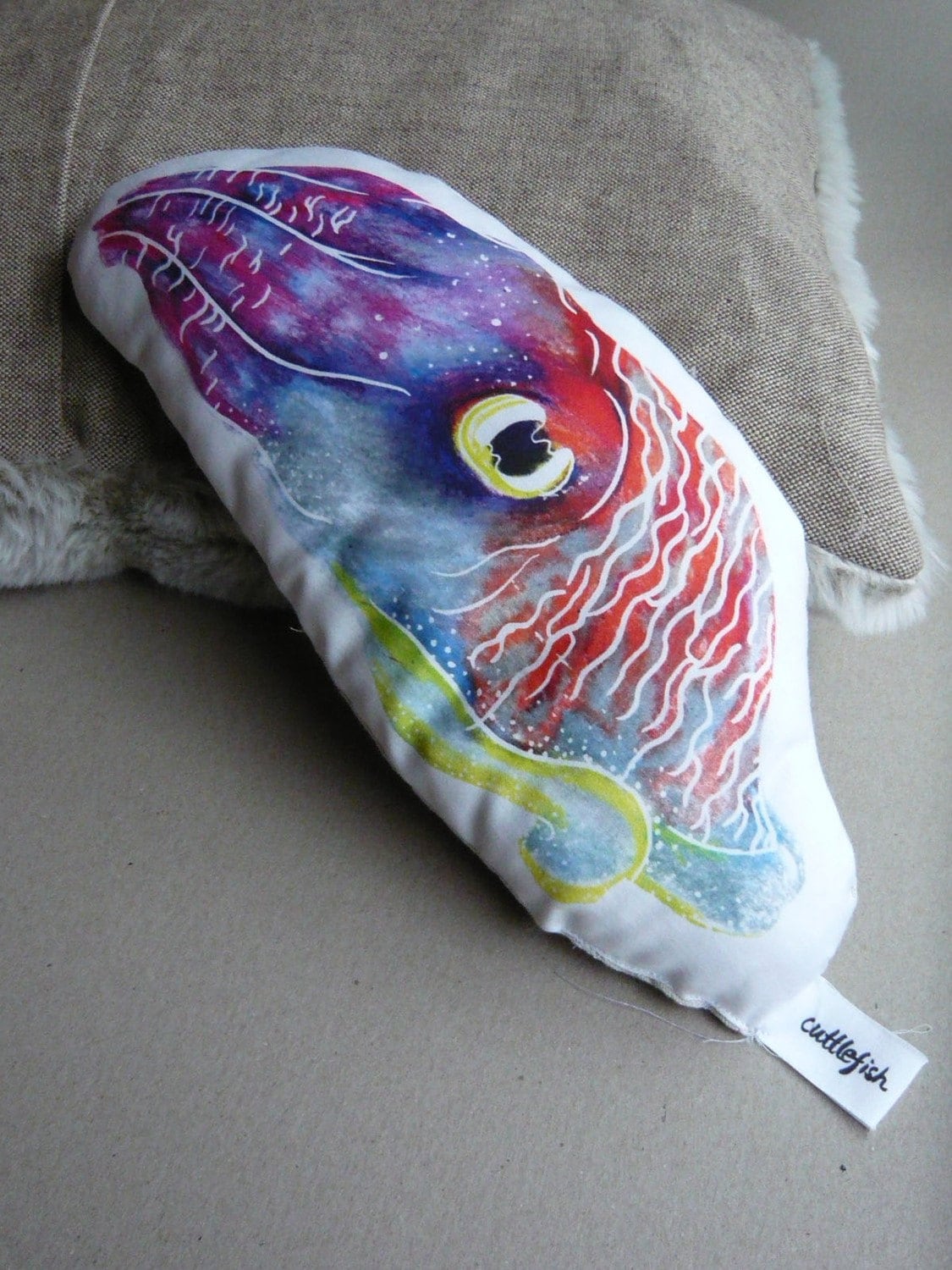
easykeeper

Easykeeper hails from Salt Lake City and does an amazing job of capturing the beautiful colors and magical skin of the cuttlefish with her Stuffed Cuttlefish Decorative Pillow Buddy. But this little guy is more than just a pretty face! Easykeeper's cuttlefish plush is printed on organic cotton and stuffed with all natural cotton fiber filling, making him a great natural addition to any home!


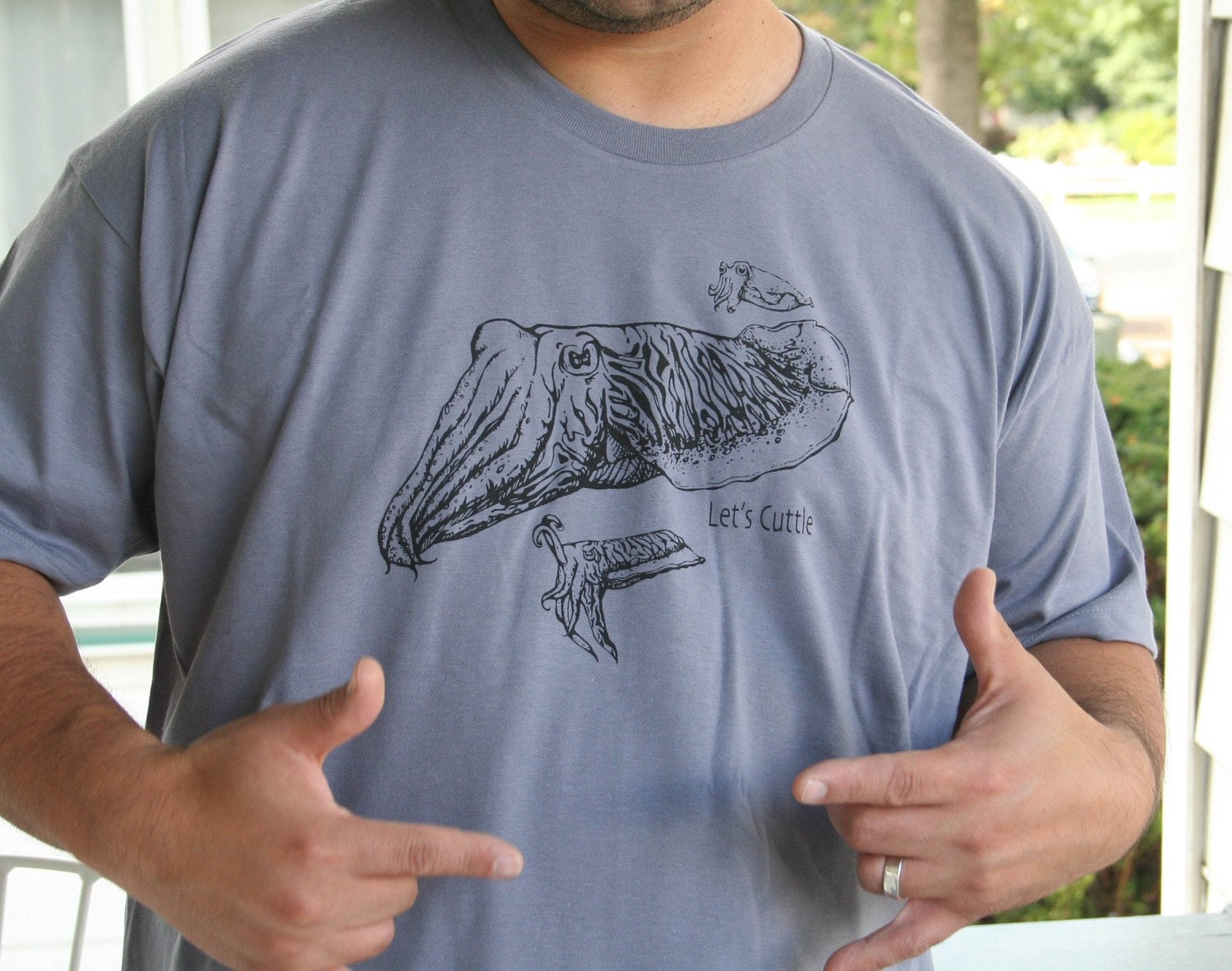
TypseyGypseyTees

TypsyGypsy is another great "cuttlefish artist". Based in Philadelphia, she creates some of the most amazing sea creature tee-shirts. The best part is, if you read her profile you will learn, all of these great designs were inspired by her 5 year old son and his precocious interest in unusual sea life! I love it! And I love her intricate representation and adorable (without being cutesy!) play on words in this wonderful tee-shirt design: "Lets Cuttle"! 

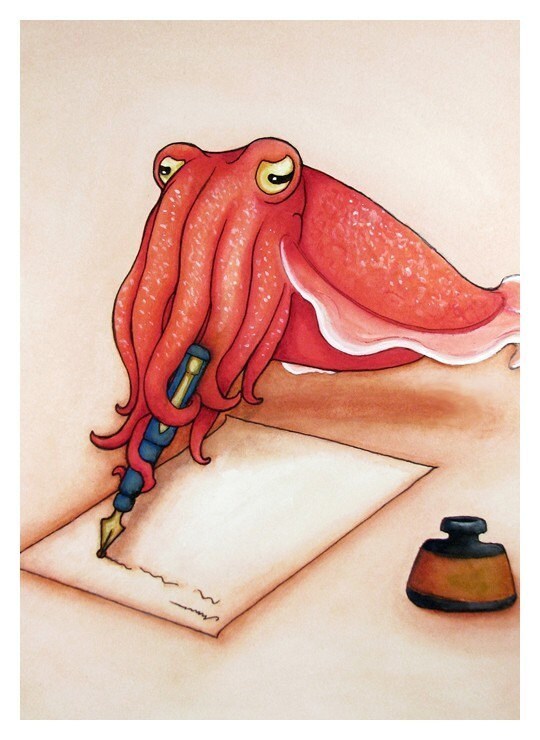
The Bonheur Letters


Finally, The Bonheur Letters of Barcelona. What a magical little slice of Etsy this shop is! Each print comes to life as the quirky personalities and daily routines of the characters are revealed. Mr. Cuttlefish Sitting in a Wishbone Chair is certainly no exception. Find out all about Mr. Cuttlefish and his proclivity for daily news at The Bonheur Letters Etsy shop!

Wednesday, December 1, 2010

Fun for Free!

Green Clay from MRH
One of my favorite parts of soap making is experimenting with new products, from rich exotic oils, to fine spices and scrumptious essential oils. Yet, it always amazes me how much the same product can vary from supplier to supplier in price, in quality and in performance.

I've seen unrefined butters with dirt and grit embedded in the butters... french green clay that looks more like grey, brown muck... and essential oils that fade or have an off scent and could easily ruin your soap. This is when experimenting becomes less of a fun adventure and more of costly nightmare.

Colored with Turmeric from MRH
That's why I love give-aways! They are a great opportunity to try some new products for free! And I am so excited because one of my favorite companies is currently running a give-away on their blog.

Mountain Rose Herbs is a great company nestled away in the funky little city of Eugene, OR.  They offer an extensive selection of natural and organic products free from pesticides and many other toxic chemicals. And right now, if you go to http://mountainroseblog.com/giveaway1/ you can find out how to enter for a chance to win some of their amazing products!

They have a french green clay of such high quality that it stays green in CP soap,  pesticide free essential oils,  and organic oils, butters, herbs, and teas at affordable prices! They are by far one of my favorite businesses!